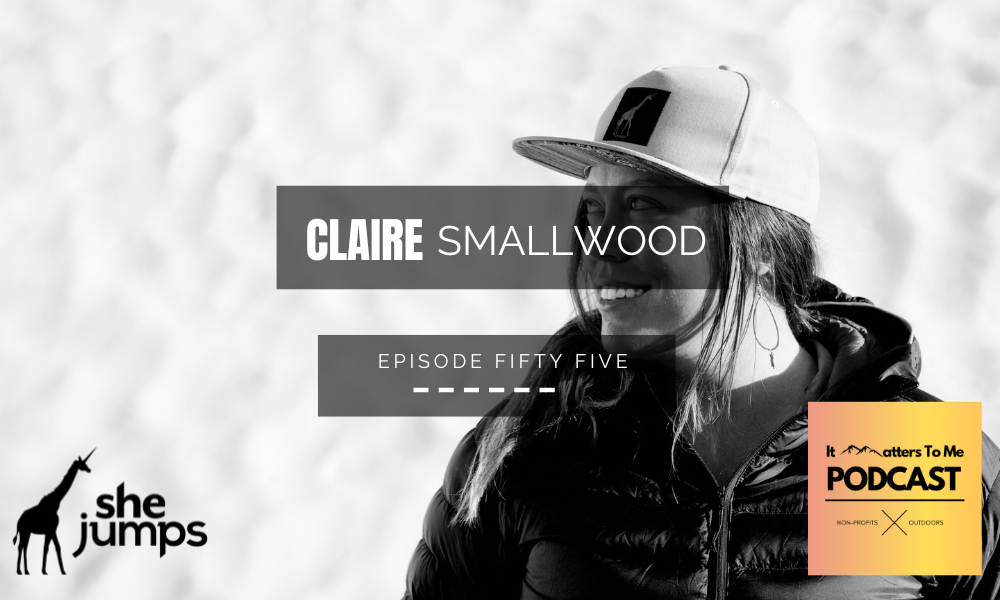
Born and raised in Santa Fe, New Mexico, Claire took her passion for skiing to the next level when she co-founded SheJumps alongside the professional freeskier, Lynsey Dyer and journalist, Vanessa Pierce in 2007.
Since then, SheJumps has created over 46,000 opportunities for women and girls to get outside by offering a variety of outdoor activities ranging from wilderness survival and mountaineering to technical maintenance and skill-building clinics.
We talk about what it was like to start SheJumps at the age of 22 and how its mission has grown over the last 16 years to include people who may not have the easiest access to wild landscapes.
We also talk about the challenges young women and girls face in participating in the outdoors compared to men and the small but meaningful changes that need to happen to address that.
Additional Links
SheJumps (Website): https://www.shejumps.org/
SheJumps (Instagram): https://www.instagram.com/shejumps/?hl=en
SheJumps (Facebook): https://www.facebook.com/SheJumps/
It Matters To Me (Instagram): https://www.instagram.com/adamcasey/
It Matters To Me (YouTube): https://www.youtube.com/@itmatterstomepodcast
It Matters To Me (Website): https://itmatterstomepodcast.com/
Partners and Sponsors
Naked: https://nakedsportsinnovations.com/
Transcript
Adam Casey: Claire, welcome to the show.
Claire Smallwood: It’s really nice to be here. Thank you so much for having me.
Adam Casey: Yeah. I can tell from the prep that I’ve been doing and the things that I’ve been learning about you and the organization that you run, that this is, going to be a really, really fun conversation.
Adam Casey: Cause I think you have such an interesting backstory and I think the work that you’re doing is really just impactful and interesting. But before we. Get into any of that. One way I like to start the show is with a fun, hopefully lighthearted question that you’re encouraged to take as deep or any off any branches that you want.
Adam Casey: I know those two analogies don’t make any sense. But if I knew you growing up, what kinds of stories would I tell about you?
Claire Smallwood: I’m giggling a little bit because My dad just came to visit me recently and I love it when you know You hear these random stories of yourself that you don’t remember as a kid and I guess I can answer that question a couple of ways.
Claire Smallwood: And, and the first way would be adventurous, but not in this way of kind of thinking about like being adventurous, just kind of, it’s just a very natural way for me to be. I’ve, I’ve just always been kind of confident, which is a great thing, especially for a young girl to have that feeling. And the story that my dad told me was that we were on vacation somewhere and We were at a restaurant, a Moroccan restaurant, I believe, and some belly dancers came up to our table and my parents were trying to encourage my older brother, Joey, to dance with them.
Claire Smallwood: And, you know, he’s like, you know, they’re spending all this time and energy going, Joey, come on. They want to dance with you. They want to dance with you. And they turned around and there I was four years old. Already dancing with the belly dancers, you know, like, and, and I think that that kind of, I didn’t, of course, I don’t really remember that, but you know, that feeling of just like, why not, like, let’s try it has always been there for me, but I would think like, as a kid and like, you know, a lot of times you’d say, oh, I was a champion this, or I was a first place that, and I never had that.
Claire Smallwood: I was never an exceptional athlete. I played on a soccer team and never scored a goal despite being a champion. a high level soccer team. I was on the swim team and I was, it was like, you know, 0. 5 seconds away from qualifying for any kind of, you know, race or anything special. And I think that that’s kind of been this feeling where it’s like the outdoors just to kind of segue into that.
Claire Smallwood: And my background, it’s that feeling where there’s not a finish line and there’s not like a, you know, determining factor to say like, you’ve made it or you haven’t, it’s just like, are you having fun and being open to the adventure?
Adam Casey: I love that because I think that is a great way to kind of transition into the work that you’re currently doing and so I would, I would be on the other side of the fence, I would call you an exceptional athlete because your background, you graduated from soccer and became, I would say, from someone who lives in Colorado, a pretty prolific skier.
Adam Casey: So how did you transition from soccer to skier into the non exceptional athlete that you think that you are?
Claire Smallwood: And, you know, and that’s, and actually that’s the thing is I actually, yeah. I mean, just except I would say standards, standardization of athletes in terms of traditional sports. Right. But there’s a great saying from Shane McConkie that the best skier on the mountain is the one that has the most fun.
Claire Smallwood: So I guess by that standard, I think I could definitely call myself. An exceptional athlete. No, but The transition when I was growing up into like, well, it wasn’t really even a transition. I, I remember my stepmom, I was about five and she decided to take my brother and I skiing one day. And I remember I loved it right off the bat.
Claire Smallwood: It was like the most fun thing ever, but it wasn’t something that we did as a family often. So I learned it. I figured it out. I think we maybe went a couple of times between the time when I was like five and when I was 10. And then I got the opportunity to do a school subsidized skiing program through my elementary school in Santa Fe, New Mexico, where I grew up.
Claire Smallwood: And that program definitely changed my life. It was mostly the fact that there was this like, freedom and unadulterated fun that you could find on the mountain. And like, most importantly, and I think this is still true to this day is that the people that you met on the mountain were of all ages and backgrounds.
Claire Smallwood: And all of a sudden you weren’t a 10 or 11 year old, 12 year old kid. Like you could write up on chairlift with anyone and become connected to them and find out a little bit more about their story or like what they’re going to ski or like talk about the weather. And I feel like that almost socialized me at a really early age to.
Claire Smallwood: See the world as my oyster in this way of being like, wow, like this is so cool. There’s, there’s this freedom here in this outdoor space. And so that program was really important because it was super cheap. It was like, I don’t even know. It was like 15 bucks or something crazy for us to go skiing. And it was like four different, you know, days we could go skiing up at Santa Fe and the ski area up there.
Claire Smallwood: And that was like, I was hooked. I was super, super hooked. And so basically I went to my. And I said, Hey, I really want to do this. And they were supportive of it for sure. But they were like, you know, this is pretty expensive. Like if you really want to do this, I think you got to pay for this yourself. So I think they probably didn’t think I would.
Claire Smallwood: Do that but basically instead of getting like a season pass like a lot of my friends had I just babysat for about four Bucks an hour. I had two younger brothers and just you know, it was 30 I think it was 32 for a ticket and then it’s like 15 for the rentals And so if I just encouraged my parents to go out to dinner several times a month I got I got a chance to go and That’s how I’ve made some of my most lifelong friendships was those times when I was, you know, just like, I would like look forward to that day on the weekend to when I got to go skiing, like.
Claire Smallwood: Beyond everything, like I would forego any other social opportunity to make sure that I could go skiing and I don’t think I’ve made a single adult decision without thinking about how I would ski since that time. And then, so that was all through high school. I was really just focused on, yeah, just skiing as much as possible, but I didn’t really know like what was possible with skiing.
Claire Smallwood: Like I was like growing up in Northern New Mexico and there weren’t a ton of. Other girls who really skied. And like, I knew some people that were on a ski team. I didn’t even really know what ski racing was, to be honest. I was like, I saw them, you know, scraping towel off this run once. And I was like, why are they doing that?
Claire Smallwood: Like, I really had no frame of reference. And I guess this shows my age a little bit because it was well before the time of being able to like look everything up on the internet. But basically I remember that when I was, by the time I graduated high school, it was like, my identity is being like, I’m a skier, I’m like.
Claire Smallwood: Female skier. I felt very proud of that. And so when I went off to college at Lewis and Clark in Portland, which I. I was really excited to go there for a lot of reasons, but proximity to Mount Hood was one of them because I was like, okay, great. I can go skiing here. I became the president of the ski and snowboard club there.
Claire Smallwood: And that was pretty formative because all of a sudden now I was in this position where I was like taking all of the things I loved about it. I was. getting to do it, the thing. And then also I was a part of the community, which was always the most important piece. So with that, I was kind of building these events and like creating connection for various, you know, for other students to go skiing.
Claire Smallwood: It helped me to make sure I could get a discounted season pass because I organized that for the whole club. And it was just kind of like, it became this. piece of me. That was a big part of my identity. And then won’t jump ahead too far, but basically started doing free skiing competitions. So my older brother was really into big mountain comps.
Claire Smallwood: And this was well before the free ride world tours. We see it today when it was a little bit more grassroots, a little bit less, maybe like swatch sponsored and all of that. And that experience Then opened up a whole new level because now all of a sudden I did have this competitive side of me that just had never won really anything that I was like, Oh, wow.
Claire Smallwood: Like, this is so cool. I can be a part of a community, push myself connect with others. And at that first ever competition in Taos, New Mexico, actually, I had flown back from, from school in Oregon. My brother and I. We’re so excited at this competition because it was basically one of our home mountains that the late great Jim Jack who for any of the listeners out there that follow the free skiing movement would know he’s passed away in an avalanche in 2012.
Claire Smallwood: However, he was the head judge of the Free skiing, U. S. International Free Skiers Association and just a legend in his own right. So anyway, my brother and I didn’t podium at this event. I think I got fifth and he got fourth or something, but they created an award for us called the Spirit Award. And it’s still an award to this day that’s given out.
Claire Smallwood: Because he was just like, wow, these two are just like, so exciting. We need to give them something. And we’ve each won that award individually at that competition. Two more times.
Adam Casey: How do you gauge the most spirit?
Claire Smallwood: And by the way, we were like in our twenties at this point, but basically I think I liked the image of the jazz hands.
Claire Smallwood: No. You win. You, I think it was probably gauged by your laryngitis at the end of the weekend or something like that. The excitement. No, I think it was just this, like, I mean, we weren’t planning it, right?
Claire Smallwood: We just had this excitement in us because part of us were like, I think we were both felt like we were being seen as New Mexico kids that grew up. And so many people just don’t even think of New Mexico as a skiing place. I think we just had this like pride and connection. And we just, we’re so excited to just.
Claire Smallwood: Be there. I don’t know. But I will say the really cool piece of it that I think is even better Is that the year after we won it in? 2006 our friend Tobias Lee won it and he later unfortunately passed away that year in an avalanche And they named it the Tobias Lee Spirit Award which to us made it feel more important But it was like then it became something about remembering Someone else in our community that had been taken too early.
Claire Smallwood: So it was kind of, I think, felt like a good, like we started it, but Tobias kind of like, I think, put the punctuation point on it. And then I think other people were able to just like, feel that. And I think they do have some actual criteria now. It’s around, you know, encouraging and like, showing positivity despite.
Claire Smallwood: You know, any hardship and you know, sometimes you can crash an event and can be really disappointing. And, yeah, maybe things like that. I could probably talk about the Spirit Award for a while.
Adam Casey: I love the origin stories of things like that where they start out as something so simple and just kind of, you know, for lack of a better term, lighthearted.
Adam Casey: And they just turn into whatever they need to turn into whatever the community needs, whatever people want to get out of it. And so a simple spirit award of just like, yeah, we’re having fun. We’re stoked, can turn into something where no, we’re celebrating someone’s life. Who had an impact on those people around them and you know, this is our way of carrying on that memory and that tradition of This person and we hope that to encourage other people.
Adam Casey: So that’s that’s an awesome story. I don’t think I would have won any spirit awards to be honest with you. The only award I would have won skiing was like who looked the goofiest because i’m quite a lanky dude but that’s that’s an awesome story. So, Claire, you are the executive director of SheJumps.
Adam Casey: And before I go ahead and just put my foot in my mouth and try to read off the mission statement or try and explain what SheJumps is, I’m going to turn that over to you and ask you, could you explain what SheJumps is and kind of what its mission is?
Claire Smallwood: Absolutely. I mean, I, it’s so funny. I mean, of course I could, I could say this in my sleep, right?
Claire Smallwood: I could just, you could nudge me in the middle of the night and say, Claire, what’s the mission of SheJumps? But I feel like before I say to the listeners what the mission of SheJumps is, I want to center everyone in. the kind of like feeling that we get when we’re at our best. I feel like the story we just talked about with like being in the spirit award and everything like what SheJumps is, is trying to bottle that feeling of connection and community in like the most beautiful outdoor spaces you can imagine.
Claire Smallwood: And you know, of course we have a 501c3 tax exempt mission, which is to increase the participation of women and girls in outdoor activities. But I think Most importantly, that’s done in partnership with nature. And really our vision is to unearth the potential of all women and girls through outdoor play and connection to nature.
Claire Smallwood: So we, you know, that looks a lot different for everybody. And that’s something that why I felt like, you know, in my In kind of thinking about who I am or, and really who we are as an organization, it’s that idea that we all come to the outdoors from different places and it’s not always the solo person standing on top of a rugged mountain peak.
Claire Smallwood: It can be as simple as sitting in your backyard, or even in a local park. And so just really wanting to make sure that we’re kind of rewriting that narrative as much as we can. I think SheJumps is, is a place where we’re creating that space to do so.
Adam Casey: And I think that’s a good point to kind of touch on in that, you know, you and I, I think you’re up in British Columbia now.
Adam Casey: You’re no longer in Mexico. Yeah. And I, I’m here in Colorado. Listeners out there won’t be able to see this. I don’t even know if you could see it, but I’m, I’m quite sunburned on my shoulders right now because of course my, I, I did not put on sunscreen today and I’ve been outside all afternoon. And so I have the benefit and, you know, you have the benefit of being outside in our mountains, pretty much just in our backyard.
Adam Casey: And I don’t think that people understand or hopefully that they’re starting to understand is that nature is Literally all around us and people that live in New York City people that live in Chicago It doesn’t seem like they’re in nature, but they’re just in a different form of nature and if they could even Just step outside whatever city block that they’re on and find that patch of grass and just feel centered In whatever, you know, whatever natural environment that they’re in that, in my opinion, qualifies as nature.
Adam Casey: So I love kind of how that’s what is becoming a lot more of a focus of a lot of organizations like SheJumps and some other ones where they’re just like, hey, nature is, you don’t have to travel that far for it. It’s where you make the most of it. And so Yeah, I’m glad I didn’t try to explain what Cheat Jones is because I probably I would have been way off I would have just not even been able to bring it around.
Claire Smallwood: And yet, and yet you would be fine because as long as we’re talking about getting outside like you said that’s what it is that we do it’s just the complexity of our organization is actually really interesting in that way because And maybe this is going to be one of your next questions, so sorry if I’m leading into it, but the complexity of this idea of, like, how do you do that?
Claire Smallwood: Like, how do you take people and either, like, you’re already connected because you grew up and your parents were like, yeah, hey, like, let’s go, we’re going to go camping every weekend, like, get in the car, like, you just, that was just what you did? Or You’re an adult and you’re like, wow, I’ve never been hiking before.
Claire Smallwood: What’s the difference between walking and hiking? Like that’s an actual question we get. And I’m like, yeah, actually, you know what? That’s a great, that’s a great question. Like there, I think what I’m trying to get at is that the connection to these natural spaces are somewhat like controlled by different systems in our society and like the exclusion that happens and why some people have more access than others and why some people’s narrative of what nature is is like this pristine wilderness is all kind of rooted in those systems of exclusion.
Claire Smallwood: So we’re always kind of trying to think about from a complex standpoint like, Okay. Like, yeah, we want all of our programs and events to be accessible, but what does that mean? It’s like, you know, for some people that’s going to mean it’s in an urban area, it’s in a park, it’s in a classroom, it’s online, or it’s in the back country because like, that’s actually where you live or the area that you really want to recreate in.
Adam Casey: So you started, SheJumps at a fairly young age.
Adam Casey: At 22, what did you see the mission of SheJumps being and fast forward to today, is that the same mission and how has it evolved?
Claire Smallwood: Okay, so being 22, you don’t really know what your plan is in general. I think that that is true of me back then.
Claire Smallwood: And I want to make sure I give Credit where credit’s due. I started the organization with two friends Vanessa Pearson, Lindsay Dyer they had actually come up with the name, SheJumps. And they had this like vision for creating this space, but it was more when I got involved, moved into being like the actual nonprofit where there was like programs.
Claire Smallwood: So the vision has always been somewhat morphing between the three of us.
Claire Smallwood: I did have a vision of this thing that SheJumps could become. I also knew I didn’t necessarily have the skill set and so I think it’s actually almost like the ethos of SheJumps is like, take a risk, like, take a jump, you know, stick your neck out, try something new. And that was in and of itself, like, I think a guiding principle that helped to like drive it into what it is today, which is like, Oh, like, let’s figure it out.
Claire Smallwood: Like, what do we need to learn how to do? I would say that the vision of helping there to be more you know, just like getting more women and girls outside was always centered from, wow, looking back when I was that girl that joined that ski, like learn to ski thing. And I should mention when I was growing up, my family was not into the outdoors.
Claire Smallwood: Like my parents were divorced. Like my dad’s side, like we never went camping. Like we did not go hiking. Like that was just not the thing that they did. And like, they just didn’t grow up doing that. Right. But we didn’t go. Like trips, like we went to the Grand Canyon and everything, but we weren’t like walking down to the bottom or doing anything adventurous like that.
Claire Smallwood: On my mom’s side of my family, it’s a bit different. They’re ranchers, but it’s like a different kind of outdoorsy thing. So again, I want to note that like for me, I was always looking back. Like who was I when I was growing up and who, what do I wish was there for me if, if I could do it again? Like that was kind of always like in my mind in my early twenties, I was really motivated by that.
Claire Smallwood: But I would say that what’s changed over the years has really been just the awakening and understanding of like, wow, like, well, I grew up and I was like, in a, you know, middle class white family, like, and I, and I didn’t really have that access, but I had the security to be able to like, get a weekend job.
Claire Smallwood: I didn’t have to like, worry about that money being saved up for like, my college or anything else. I mean, I did work all through high school, but it was like, I just had privilege. And so I think it was more that like, it wasn’t as simple as I think in the my early twenties, I was like, yeah, I’m like, we can like get you out there and like, yeah, like no problem.
Claire Smallwood: Everybody can come versus now. I’m like, Oh wow. We need to address inclusion. They get a really big way because it’s not as easy as just like, yeah, just like go hiking. Like what’s the big deal. Like, I think that’s like often. And you said that like, you know, more nonprofits are starting to address it like outdoor access in this way.
Claire Smallwood: It’s not as simple Just go like, why not? Like there’s just such a deeper iceberg to it. So I think over the years, that’s really been the shift has been like just a deeper thought process and examining of the relationship that we have with the outdoors, the narrative. And then of course, because we are a women’s focused organization, more of the patriarchal narrative of like who belongs in leadership positions in those outdoor spaces and why women.
Claire Smallwood: Kind of talk down to themselves in a way that you don’t typically hear men do that’s like I’m gonna be super slow like go for it. You go first, you know, or like I you know And I’ve heard myself say it I’m not immune to it by any means but just kind of I think there’s like a little bit Of an iceberg to it when you’re 22.
Claire Smallwood: You’re like, yeah, it’s like gonna be great Like everybody’s just like gonna go outside and have such a good time and then you’re like, oh wow It’s a bit more complicated. I thought so I would say it’s more like you know, kind of peeling back the layers and, and for me, like staying, it’s been hard, right?
Claire Smallwood: 16 years is a long time. And just so the listeners kind of get a sense of the operational scope and scale of SheJumps, like we have right now, I think about 140 volunteers in 16 States and really like our organization was built on volunteers. I didn’t even become full time for SheJumps until 2017. So not that long ago.
Claire Smallwood: Yeah. And so I just think like for me over the years. From being 22 and being like, sweet, like, let’s go and go for a hike to like, being like, wow, we built this big organization. It has come with. For me needing to recenter, and I’m sure this is true of all of your podcast guests, like you, like, it’s hard to run an organization and to do this work because you can burn out really easily.
Claire Smallwood: But for me, recentering on like, what have I learned? Like, what do I have the courage to like address? That’s like now the new thing that we need to do, like, it’s not just as simple as like, sweet, we did this thing, you know, kind of trying to push a little bit further.
Adam Casey: Technically I do manage a charity on my own.
Adam Casey: It’s a charity that helps low income students from St. Louis with partial scholarships. And talk about burnout, I mean. Oh, boy, like, you know, it’s been going I started this in 2012, right before I joined the military. And right now I’m still fortunate enough to be able to support a few students, but I’m just gonna say like a lot of that money comes out of my own pocket and you know, friends, and family members.
Adam Casey: But there are those moments where you’re just sort of so motivated and you’re just like, Oh, I’m going to change the world and it’s not as easy as just setting up a charity and putting out one Instagram post and having people turn over all your money.
Adam Casey: So, that recentering feeling. I mean, it’s. It’s so necessary because I don’t know how you prefer to rediscover why you’re doing what you’re doing, but it’s just so important so I really do sympathize with that.
Adam Casey: I want to touch a little bit more on not just the inclusion of just like being able to go outdoors, but obviously what SheJumps primarily focuses on is women in the outdoors. And this is, this is going to be one of those stupid questions I warned you about before we hit record, but why do you think there are less women active and in the outdoors than men?
Adam Casey: And why do you think that they, there is that barrier to entry, not just of like getting outside, but from a gender side of things, getting women outside.
Claire Smallwood: I think it starts from a really young age, where there’s just narratives. I think that there’s just narrative around playing outside, around what you’re choosing to, how you’re choosing to play for kids.
Claire Smallwood: I mean, studies show that by the age of six, girls are less likely to be encouraged to play outside than boys are in like preschool and like, earlier age you know, education scenarios. And so I think like, you know, I can relate to that as well. I, I have three brothers, but I do remember that it was like, there’s an assumption that’s really deep within our parents and like different generations.
Claire Smallwood: That’s like, women are the hunter gather or the hunter gather kind of. You know framework like women are the gatherers and they’re like the communal focused group and and yet like there’s no reason that they can’t also hunt right just like there’s no reason why like the men couldn’t also gather it’s just where these were the traditional like gender roles that were created and obviously we see that in modern day like you know the domestic housework that does in a typical nuclear family like you know it’s typically like a lot more than maybe you a partner would do so I mean I think like back to like the reason like why women and why this and like, why is this even an issue?
Claire Smallwood: I just there’s how much time do we have to talk about the patriarchy all the time in the world? No, I just think there’s just it’s narratives from a really early age. That’s like, you know, women are not told that they have to be. They’re told. In general that, you know, in general kids are, and we know this from like the participation ribbons and like the ways that, you know, kids are raised and stuff and this, there’s a lot of complications here, right?
Claire Smallwood: But bear with me. What I’m trying to get at here is the fact that like, you know, if you’re kind of told that you have to be everything, It’s always really easy to kind of steer away from something that’s more of an unknown, especially if you can’t be what you can’t see. Right. So, I mean, I feel really lucky, like my generation, we all had women that we could look up to that were, you know, portrayed in the Olympics.
Claire Smallwood: Like we had just more access after Title IX. And actually we had a board member, Connie Marshall who is a legend in and of herself. She served as the marketing director at Alta Ski Area for 45 years. But she was in high school when Title IX happened. And so she was actually able to gain access to sports through Title IX, which said that women basically needed to have the same access to these organized sports in high school as, as boys did.
Claire Smallwood: And prior to that, she didn’t have any out, any sort of physical outlet that was like sanctioned through her school or through anything else, right? So, imagine like if you grew up with a mom who was like that and then they don’t really know any different. I just think again, the narrative that’s said is like, yeah, like it’s fine.
Claire Smallwood: You don’t need to do that. That’s like what the guys are going to go do. You know, I think that that just.
Claire Smallwood: And I think that there’s a lot of pressure put on women to just if you’re going to do something to do it really well, and I think that that feeling around wanting to ask questions and wanting to learn, but not wanting to think if I make a mistake, I’m going to be reflecting on all women. One example of this is like, there’s this is just like, again, narratives, like little subtle cues.
Claire Smallwood: Rogers pass is a famous backcountry ski area in British Columbia. And in like the closest run that you can do from the parking lot is called the girlfriend run. Like, and I, and I think, right. And it’s like, and it, okay, well then I guess that’s where, that’s where the women go. Like, right. Unless you were told differently, that’s not a space where you’re told that you belong.
Claire Smallwood: And I think that that’s kind of the rewriting of the narrative is one where it’s like, Hey, you know what? Like no one comes out of the womb knowing how to do any of this stuff. Any gender, right? So that’s just first and foremost. So then if that’s the case, how do we create these spaces for empowerment?
Claire Smallwood: So that from a young age, and our program started at a really young age, they’re like, our participants are seeing women in Powerful roles or in leadership roles. So they’re going, oh, I, I could do that one day. That could be my job. I could be a ski patroller. I thought there were only men that did that. I thought it was only men that were firefighters.
Claire Smallwood: You know, and again, it’s just more of the representation matters. We see that a lot. And the reason why representation matters is because you can’t be what you can’t see.
Adam Casey: It’s very true. For me, have a background in the military and there’s, I guess still controversy about allowing women into combat roles and from day one, not that I’m trying to like virtue signal or like pat myself on the back, but from day one, it was, in my opinion, it was like, yeah, if you meet the standard, you meet the standard.
Adam Casey: I don’t care who you are. If you want to be a dirtbag like me, not showering for a few days at a time, just doing some of these things, I don’t care who you are, girl, guy, you know, it’s like I said, the bar is set to where it ever it is and whoever meets it, I think is good on them.
Adam Casey: And, I think that’s kind of where we’re seeing a lot of generational change right now. And a lot of these things where those institutions of 30, 40 years of G. I. Joe versus like a G. I. Jane , but I think it’s that it’s those small hidden narratives that need to change that that are the most impactful.
Adam Casey: Let’s talk a little bit more about like the programs that SheJumps offers and if you could walk me through what it is that if someone comes to a SheJumps event, what they can expect to experience and kind of what you hope that they leave with.
Claire Smallwood: Well, and that’s thanks for the opportunity to talk about that. I feel like again Most folks kind of, okay, actually let me say something. We gave a survey a few years ago and I remember being like, Hey, which event did you attend? Which program did you participate in? And like of our literally 3000 participants, we didn’t get everyone to fill out the survey, but like the large percentage of people couldn’t even remember what program they went to.
Claire Smallwood: So just remember that if you want to go to a SheJumps event, the chances are you’re going to meet some fun people, do something, learn something and. You know, have fun, really, the take home. However, we do have some structured programs and I’d love to tell folks about that. So Wild Skills is our youth program, starts at age six, and it includes and it goes up from there.
Claire Smallwood: So we have Wild Skills is a day camp where we teach foundational outdoor skills like Leave No Trace, First Aid, Tent Essentials Shelter Building, and Navigation. These are really fun events. Imagine, like, a day camp where everyone’s got, like, face paint and tutus and superhero capes. And you’re learning all these great skills from local female guides, nurses, search and rescue pros, etc.
Claire Smallwood: It’s really fun. We try to make this as free or cheap as possible. So usually a 10 donation and that’s a really… Important commitment that we have to just making sure that young girls show up and they learn some super basic skills that one day could totally save their lives or just help them have a better adventure.
Claire Smallwood: We also offer junior ski patrol as well as junior wildland firefighter events. So those are where we’re, again, more career-based training for young girls that started age eight and go up from there. And then the bread and butter of most of our programs for adults. Really around outdoor education.
Claire Smallwood: So this kind of falls into two big camps. We have community initiatives that are kind of more focused around social events, wanting to connect and meet with people, maybe gain access to mentors, make connections for other adventures, and then education events where we’re offering some kind of technical skill.
Claire Smallwood: This could range from, you know, bike maintenance clinics. To we’ll do like, you know, climbing events learning how to kind of like get technique there as well as physical conditioning or training for injury prevention. And then we have some more famous ones like our Alpine school, which is a ski mountaineering course for women ski and split board.
Claire Smallwood: And recently we actually transitioned this to have a classroom component as well to make it more inclusive. Cause we know not everyone can travel to British Columbia to do these great. Programs and events. And then we also have river school where we’re focusing on fly fishing river ecology and all those kinds of great things.
Claire Smallwood: And then finally, a really fun way anybody can get involved is we have fundraising climbs. So if you’ve ever been interested, you have a bucket list. You’re like, I really want to climb Mount Rainier. You can do that with SheJumps, raise money in the process to support all of our free and low cost programming.
Claire Smallwood: We have six different climbs we offer annually ranging from Mount Rainier to the Grand Teton. So lots of different ways to get involved.
Adam Casey: Having these events where other people can participate in is so important because they’re not only just, spread awareness about what it is that you’re doing, but it just gives someone their own kind of investment into bettering their community because I think at the end of the day what makes the charity successful and what makes nonprofits successful is not just like having an impact, but letting the members of their community know that they’re making this impact and bringing other people in that are affected in one way or another to be a part of that change.
Adam Casey: Drawing people into things that like they enjoy doing that actually brings them together as a community. There’s just something intangible about it that I think is kind of undervalued when it comes to helping nonprofits survive. It’s no, no surprise that SheJumps is probably really doing that to a larger degree and having much more success than I’ve seen in my own shoes, but when it comes to actual involvement from other people is SheJumps limited to women or is, do you have a lot of male participation?
Adam Casey: Do you have a lot of guys coming to you and being like, Hey, I get it. The organization is called SheJumps, but this is something I still want to be a part of and I want to help out at.
Claire Smallwood: Yeah, absolutely. I mean, we’re an inclusive organization, so are we welcome at our, at our events and our programs, we try to be as specific as possible for the particular audience that we’re trying to support.
Claire Smallwood: We welcome all women and girls, transgender and cisgender, as well as non binary. People, but however, we have a lot of community focused events where we encourage. Anyone and everyone to come you know, we’re trying to address kind of unintentional inclusion around that front because we have we recognize that gender is a spectrum and we’re trying to really be thoughtful around the fact that our organization was formed really in response to exclusionary tactics itself so we’re trying to like make sure that we’re being very mindful around like who’s welcome and like how can we ensure that they feel included in belonging at those particular events.
Claire Smallwood: But kind of the short answer to your question is it depends on the event for male identifying participants and support. And, but we certainly have quite a few where people can get involved. Speaking of which you mentioned donating and I forgot to mention, well, maybe I was thinking, maybe it was waiting for the perfect time to talk about this, but one of our bigger programs that Falls into the categories I mentioned earlier is our snowpack scholarship, which is really interesting because like a lot of people are like, well, how do I make a difference in the outdoors?
Claire Smallwood: Like how do I really, I support it, but like, I really want to donate, but I want to make sure I’m donating to a program that really kind of pays it forward. Because of course, as a nonprofit, our snowpack scholarship is pretty incredible. We offered 84. Scholarships last year for women. And 51% of those were for women of color to gain avalanche education certifications in four different states. So it’s probably one of the largest, if not the largest that I’m aware of scholarship program for women in the outdoors.
Claire Smallwood: Particularly the fact that we actually book out entire courses. So back to kind of that like community environment where we’re like booking out an entire scholarship course. So everybody on that course is receiving a scholarship and gets a chance to connect with one another, which is really fun.
Adam Casey: And how are those scholarships funded?
Adam Casey: Are you able to actually do that through like just individual donors or individual people giving like 10 dollars at a time. Or do you have maybe large organizations that you partner with that are able to fund a majority of that?
Claire Smallwood: We work with corporate donors quite a bit, corporate sponsors.
Claire Smallwood: So Nordica is a big supporter of ours. In fact, Nordica is they’ve supported our icon pass scholarship, which is another portion of the snowpack scholarship where we give. 10 icon passes to women of color, specifically actually 100% of those go to women of color to address exclusion. That’s, you know, basically the outdoor industry is prominently white.
Claire Smallwood: So really Nordica, along with K2 skis and Yeti actually is a huge partner of ours. So we do a combination of that, but ultimately when We are shortcoming from our corporate funding. We’re relying on those individual donations to cover the gap. So we’re, we’re really our fundraising climbs are a great way that we’re able to gather those individual donations and then distribute it to the programs that need it the most.
Claire Smallwood: But yeah, ultimately we’re, we’re, we do have a lot of corporate donors that, but the snowpack scholarships, a great way to support us indeed.
Adam Casey: One thing wish we could spend a little bit more time on because I know you’re a big advocate for is that volunteer network that you have?
Adam Casey: How did you go about like building that volunteer network? Did that start out with just friends and family and you getting one or two people at a time or was Or was that something that just kind of was organic on its own and now it’s just become something where you have I think you said it’s 150 volunteers or over 150 volunteers
Claire Smallwood: We just did a big recruitment and actually I’m not even a hundred percent sure on what the final roster count is at this point, but it’s a lot. And no, to answer your question, we actually started SheJumps when we started in 2007, we were super grassroots. It was very much like word of mouth.
Claire Smallwood: And it was like friends of friends initially for our first programs that we hosted. And it was people reaching out and saying, Oh, I want to host an event. And we’re like, here’s some stickers, like get some email addresses. No insurance. We were kind of a little bit, you know, grassroots as you mentioned.
Claire Smallwood: Anyway, so then in 2012, I blew my knee out and was laid up on a couch and kind of decided to take it to the next level in terms of just wanting to find help and support and had a really great gal named Tamara. Jar who was from the east coast, had never met her. She reached out and was like, I have all these ideas.
Claire Smallwood: And she was the one that originally pitched us on this expansion and this model of having regional coordinators and volunteers in all these different states. And so in 2013, we launched a new website and not the one you see today, a couple versions ago, but that was kind of the beginning of it. And I think in that first push for those regional volunteers.
Claire Smallwood: I think we had like 50 or 60, so it really was a grew a bit bigger than I think we had intention or like ability to manage. But so those years between I would say 2013 to 2017 was kind of like the word of mouth spread really fast. And I think in some ways we couldn’t catch up operationally, but the same in the same way it built this amazing network of connection and people that had SheJumps experiences.
Claire Smallwood: So then it’s built us into the success. I think that we’ve seen today with our new volunteer network where now we provide great training and you know, we have quite a bit of structure to our volunteer program now and we now treat it as if it’s its own program. Really like we’re investing in it. We’re tracking it.
Claire Smallwood: We want to evaluate these volunteers and help them to really feel like they’re gaining leadership skills, building their self confidence and things that will really apply to their everyday life. So we’re not just saying like, Hey, go out and host these events for us. It’s like, we want it to be intrinsically valuable for them as well.
Adam Casey: I want to know, what do you think is the most important thing for you to focus on at this time?
Adam Casey: And do you think you need to kind of control that growth? Because like you said, you know, all of a sudden you end up in a position where all the, you know, 50, 60 volunteers coming out of nowhere and you operationally don’t know what to do with them.
Claire Smallwood: First and foremost, I think the safety of our participants and our volunteers is the most important piece of being a sustainable organization. So in our strategic plan, that’s actually our primary goal is just Obviously to be a sustainable organization. I think we’ve achieved that to a certain extent from building some operations, procedures, fundraising models, etc.
Claire Smallwood: But, I would say that the next iteration and stage of SheJumps becoming a more mature non profit is Probably just in a better sense of that footprint in each region of meeting community needs with where they’re at. I think that that’s the difference, right? Like the programs that are successful in Seattle are not the same programs that are going to be successful in Alabama.
Claire Smallwood: And that’s not an area that we currently are in, but I would say in terms of, you know, kind of keeping sustainable sustainability at the forefront and knowing that the safety of our volunteers and our participants are the most important. I would hope that in 16 years we’re able to say, you know, yeah, we have participants in every, in all states.
Claire Smallwood: And that we’re really, again, meeting the local needs of the community and not taking that from a blanket approach. I think that’s kind of been what we’ve done in the past is like, we have an idea for a program and our event, and maybe a great example, this is our get the girls out event, which is a very ski focused winter event.
Claire Smallwood: Well, hey, there’s not ski areas and all these places and climate change continually puts that into questioning as well. So we need to be thinking about like how we’re making this a more inclusive event. And I would think that we would be wanting to consider how we look at all of those areas and, and really making sure that we’re addressing again, local needs, as opposed to just what we see nationally as a vision for outdoor success and play.
Adam Casey: And I appreciate that question a little bit more now after talking to non profit leaders and just realizing that you would think that the answer is just, yeah, I want to see us take over the world and we’re going to be in every country and we’re going to be doing this, this, and this, and they’re like, no, the lessons I’ve learned along the way were don’t overextend yourself.
Claire Smallwood: I mean, yeah, we’re really looking right now at quality over quantity. I mean, we, for a long time, I mean, we actually, I say that, and then we just wrapped our fiscal year and we hosted 200 events, which is like the most events we’ve ever hosted in a fiscal year.
Claire Smallwood: So I keep trying to say quality over quantity, and that’s really what we’re trying to dig into now with like data and all of that, but it’s just really, so I believe in this thing called the Well, it’s, I believe in the curb cut theory. Have you ever heard of that before? No, please do tell. Okay. So the curb cut theory is and I’m probably gonna botch the name.
Claire Smallwood: I want to say it’s, you know what? I’m not going to say the name of the person that I think came up with it. Cause I think I’m going to get the name wrong, but the curb cut theory is something you can Google. And basically the, the premise is really simple. It’s this idea that if you cater to the person who is least who’s like most disabled or like has the least amount of access to a space or an area, you were automatically going to make it better for everybody.
Claire Smallwood: So where this came from was Berkeley, I think in the seventies, disabled students protested about the fact that there were no curbs anywhere for them to roll their wheelchairs up on. So they decided to pour their own curbs. For ramps and essentially people at first they were in trouble, but then long story short, everybody realized, wow, this makes it easier when I have to carry heavy boxes or maybe I’m rolling a piano into a building or a woman pushing a stroller.
Claire Smallwood: So it’s just this idea that, you know, again, if you’re really focusing on the person that needs the most amount of support to be successful, like that’s kind of where we’re at. We want to think about like, okay, like. Can a Black, disabled, trans woman attend this event and feel safe and supported? And I’m just using that as one example.
Claire Smallwood: It’s not the only example. It’s on a spectrum of ways in which exclusion happens. I, I, just, it’s an example where I actually think that the answer to that for a lot of our programs is no. And that’s an honest answer. I’m just trying to say, like, I think, As nonprofit professionals, like that’s kind of the exhaustion.
Claire Smallwood: And also I think back to that thing around recentering, the exhaustion can set in, cause you can go, wow, I can’t fix all the problems. Like, oh my gosh, like this is so overwhelming and there’s not enough money and there’s never enough help, but it can also be this thing. That’s like, right. But like, let’s remember what the thing that we’re working towards is because ultimately like the sustainability of.
Claire Smallwood: What we do as an organization has to be like measured towards a goal that everyone can appreciate and along the way To making the event as accessible as possible or making the outdoors as accessible as possible You will make it better for everybody else So that’s something that for me really kind of when I think about the future experience of SheJumps.
Claire Smallwood: I’m like, okay How can we make sure that along the way, we’re just answering this question over and over again, which can be the definition of insanity, but we’ll eventually get there.
Adam Casey: I think that’s the definition of very mature intelligence because it just reminds me of the phrase rising tide raises all ships and in some ways focusing on that, like focusing on the person who needs the most help.
Adam Casey: It seems so intuitive, but it’s yet it’s so difficult to do. So I think that’s great. I’m, I, I, I just learned something new and that’s awesome.
Adam Casey: Well, we’re kind of coming up to you know, time and I want to be really respectful of the the time that you’ve already given me. But before we go, SheJumps has for the last 16 years, no doubt had an impact on, I’m just going to say like hundreds of people at that point.
Adam Casey: But what I want to know is how has SheJumps impacted you and how has running this organization and continuing to be involved in this organization impacted you in a way that keeps you motivated to day in and day out just grind?
Claire Smallwood: That’s a great question because in some ways I think it’s easy to lose yourself in this work and to like, especially because I started it from such a young age and for the background, like during those years when I wasn’t paid, I was working as a private chef and it was a really fun job and I was skiing every day and kind of running SheJumps in my spare time and cooking at night.
Claire Smallwood: It was really fun. It was like a great period of time in my life. I think that period of time in my life in some ways was A really important foundational piece because say I had started SheJumps and like somehow I had funding and like was paid right away and it was like my full time job. I don’t think I would have, I don’t think that it could have lasted.
Claire Smallwood: I think that there was an appreciation for the hard work and commitment to a long term goal that it developed in me of this deep commitment and almost a stubbornness to be honest about like, I want to see this thing work. I want to see this thing happen. So I think that. SheJumps has impacted me. Well, I mean, I can say first and foremost, I’ve met all of my best friends through this organization and had incredible experiences.
Claire Smallwood: And, and I think that in the end it’s just reminded me that as human beings, like we all know what, at the end of the day, what we do, what we’re, what we’re contributing to. And so I’m reminded that You know, one of our first early on sayings or, or kind of like motto was what great thing would you dare to accomplish if success was the only possible outcome?
Claire Smallwood: So it’s encouraged me to explore new parts of my personality and remind myself that just because like, I kind of see myself where I’ve experienced myself as a skier and like, that’s my identity. And like, that was so important to me and wrapped up for me, especially in my twenties that like, it’s really, really fun to become a beginner again.
Claire Smallwood: And I think that that’s. The thing for me that I learned constantly through our participants is just like reminding that like that first time of exploring and, you know, riding up that chairlift with an, I remember this older woman, I was 10 years old and her name was Gail and I’ll never forget that chairlift ride.
Claire Smallwood: That was so many years ago. So I liked that idea that I can remind myself that it’s always okay to start new and start fresh. And again, no one was born knowing how to do anything. So SheJumps as encouraged me to remind myself that it’s always okay. And it’s a good idea to kind of become a beginner again, every, every now and then.
Adam Casey: That’s that’s a great message.
Adam Casey: Well Claire, this has just been a, it’s been a beautiful conversation for me. I know that I’ve tried to touch on a few different topics but it’s just been it’s been so much fun, just learning about SheJumps and learning about you and just having this conversation with you.
Adam Casey: So thank you again for taking the time to talk to me.
Adam Casey: And what would be the best way to pay for people to get involved with sheet jumps and maybe learn about the work that you’re doing?
Claire Smallwood: Well, we’d love it if you’d follow us on social media.
Claire Smallwood: You can find us at at SheJumps. But of course, if you join our newsletter, you’re going to be the first to know about events online and local in your area, as well as how to get involved in other ways with volunteer opportunities as well. So we’d love to connect with you online and you can also follow me at, at Claire Smallwood underscore.
Adam Casey: Awesome. Well, Claire, I really appreciate it again. And I hope that we get to talk again soon.
Claire Smallwood: Yeah. Adam, thank you. You run a great podcast. I’m so honored to be part of it. Thank you. Bye.
 It Matters To Me Podcast